DESAL GENSETS®
The INDUSTRIAL Energy and Water Desalination Solution
Clean desalination + reverse osmosis water, with permanent electricity
Our Desalination Water + Electric energy generators
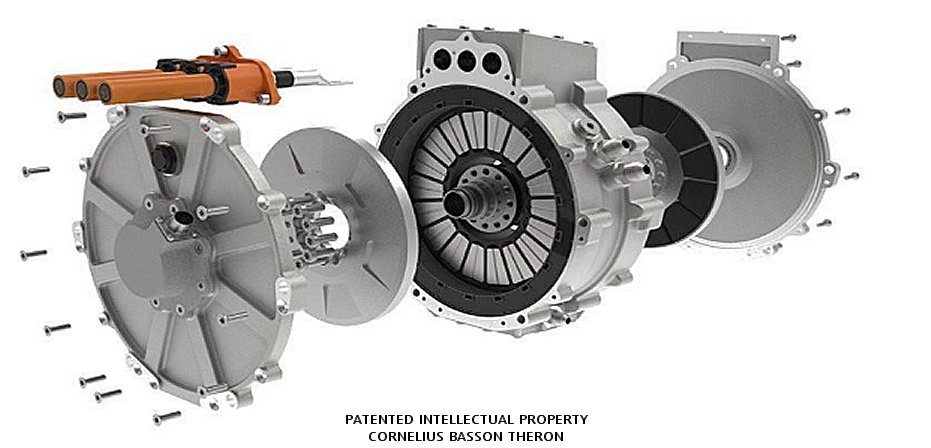
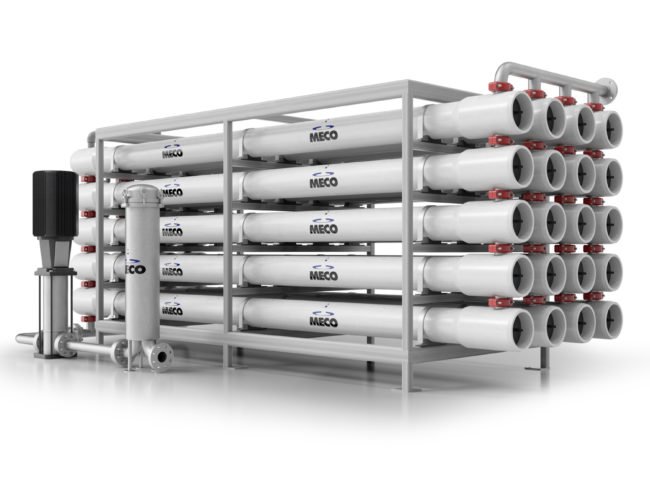
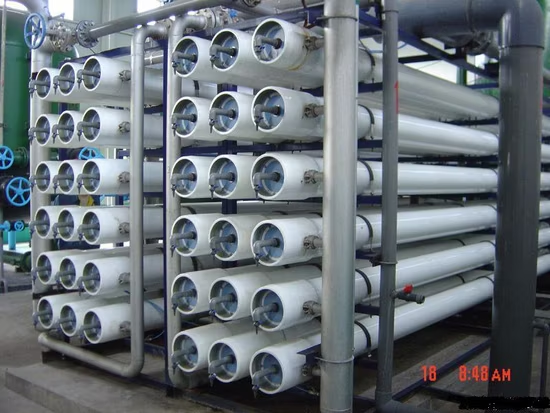
THERON ENERGY IS PRODUCING TWO DESALINATION PRODUCT LINES.
To maintain a 660,000 GPD output of medical-grade water, a standard RO system cannot simply be “cranked up”; you must add a second stage of RO filtration and continuous electrodeionization, which requires roughly 2.2 to 2.5 times more RO membranes than a standard drinking-water system. If you try to run medical-grade filtration through a system originally sized for 660,000 GPD of drinking water, your output volume will crash by 40% to 55% (down to roughly 300,000–396,000 GPD) due to the low-recovery nature of high-purity water systems.
1. Calculate Single-Pass vs. Double-Pass Drop
Standard drinking-water RO is a single-pass system that operates at roughly 75% to 80% recovery for brackish water (or 40-50% for seawater). It leaves behind too many conductive ions to meet medical standards. [1, 2]
Medical-grade water (such as USP Purified Water or Water for Injection) requires a double-pass RO system. The product water (permeate) from the first RO system becomes the feed water for a second, completely separate set of RO membranes. Because the second pass rejects a portion of its feedback to the front of the system, running a medical loop on a standard single-pass footprint drastically starves the output.
2. Factor in Continuous Electrodeionization (CEDI)
RO membranes alone cannot reliably hit the extreme purity metrics required for medical applications (< 1.3 μS/cm conductivity). A medical system must pass the second-pass RO water through a Continuous Electrodeionization (CEDI) block. CEDI modules use electrical currents and ion-exchange membranes to strip out remaining trace minerals. CEDI systems introduce an additional 5% to 10% reject rate, further reducing total system recovery.
3. Compare Membrane Count and Sizing
To achieve a net output of 660,000 GPD of medical-grade water, the front end of your system actually has to process significantly more water to compensate for the multi-stage losses.
| Metric | Drinking-Grade RO | Medical-Grade RO (Double-Pass + CEDI) |
|---|---|---|
| Net Product Output | 660,000 GPD | 660,000 GPD |
| Required Feed Flux Rate | Lower pressure, standard flux | Lower flux per membrane to prevent fouling |
| Pass 1 Permeate Needed | 660,000 GPD | ~735,000 GPD (to feed Pass 2) |
| Raw Feed Water Required | ~880,000 GPD | ~1,000,000+ GPD |
| Relative Membrane Count | 1.0x (Baseline) | 2.2x to 2.5x more pressure vessels/tubes |
4. Address Cross-Contamination and Material Rules
You cannot use standard fiberglass or PVC water tubes for medical-grade output. The second pass and CEDI piping must use orbitally welded 316L stainless steel or high-purity PVDF plastics. The system must also incorporate periodic chemical or hot-water sanitization cycles (80°C to 85°C) to prevent biofilm growth, which means the membranes themselves must be premium, heat-sanitizable models.
✅ Summary of Requirements
To hit a strict 660,000 GPD flow rate for medical applications, you cannot reuse a standard 660K GPD drinking water plant design. You must explicitly build a larger multi-stage system containing at least double the total number of RO membrane tubes, paired with downstream CEDI modules and stainless steel distribution loops.
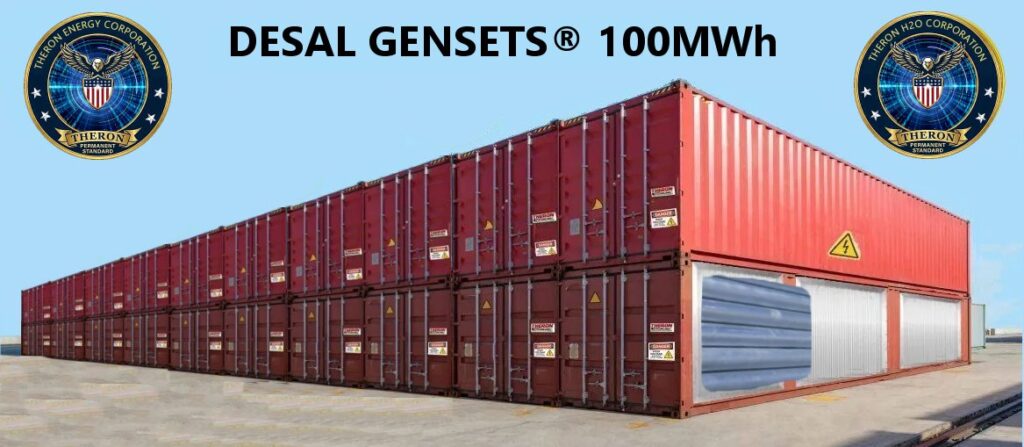
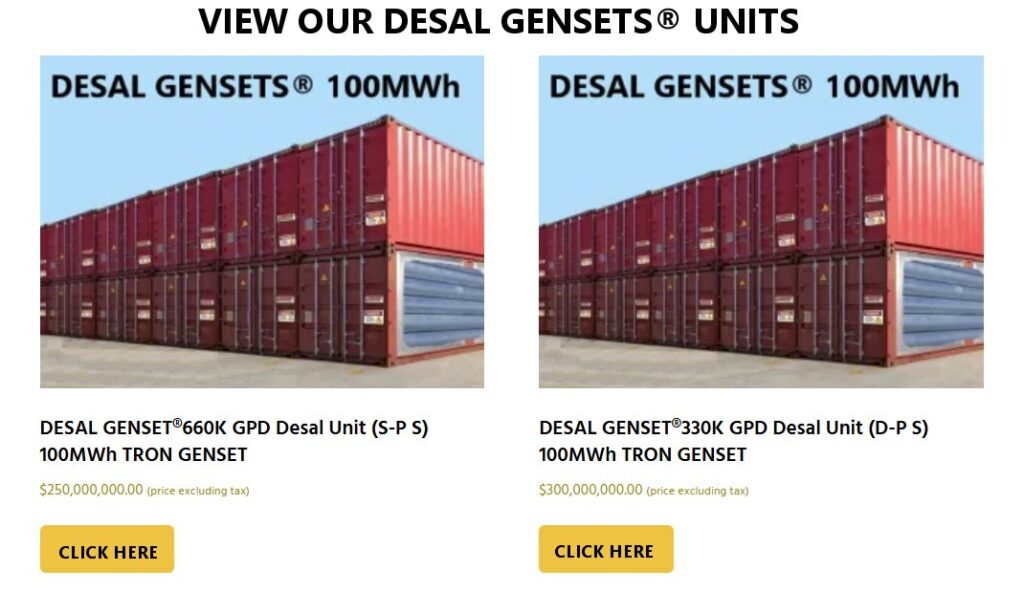
2 TIER DESAL GENSETS OPTIONS
The new engineering of our DESAL GENSETS:
- PURE EARTH DRINKING WATER thru S-P S RO – 660,000 GPD
- PURE EARTH MEDICAL WATER thru D-P S RO – 330,000 GPD
Engineering Specs:
- All tubing made from Stainless Steal, not PVC.
- Medical grade tubes, 5-7 filters.
- Drinking grade tubes, 3-5 filters.
| Product Tier | The Hardware Loadout | Strategic Price Point (PP) | The Value Proposition |
| TIER 1: Industrial Desalination | • 1x 100MWh TRON GENSET • 1x 660K Gal/Day Desal Unit (S-P S) Single-pass System | $250,000,000 | Produces PURE EARTH DRINKING WATER. Total sovereign industrial water production for heavy agriculture, raw mining operations, and municipal baseloads. |
| TIER 2: Medical Grade / AI Nexus / Desalination + RO | • 1x 100MWh TRON GENSET • 1x 330K Gal/Day Desal Unit (D-P S) Double-Pass System (CEDI) • 1x Industrial RO Filter Unit | $300,000,000 | Produces PURE EARTH MED WATER. The ultimate solution for AI Data Centers, pharmaceutical manufacturing, and hospitals. |
HIGH PRESSURE DESALINATION
High-pressure desalination refers to the industrial process of forcing saline water through a semi-permeable membrane at pressures usually ranging from 55 to 70 bar (800 to 1,000+ PSI) to separate pure drinking water from salt and minerals. It is the mechanical foundation of Seawater Reverse Osmosis (SWRO), which accounts for over 80% of global desalinated water production.
The Desalination Core Mechanism
Under normal conditions, natural osmosis causes fresh water to flow toward salty water to dilute it. To reverse this process, a high-pressure pump must supply intense hydraulic force that exceeds the natural osmotic pressure of the saltwater feed. This forces pure water molecules through microscopic membrane pores (roughly 0.1 nanometers) while blocking dissolved salt ions, bacteria, and debris.
How High-Pressure Desalination Works
The process relies on intense physical force to reverse the natural phenomenon of osmosis:
- Pre-Treatment: Seawater is drawn into the facility and filtered through micro-screens and chemical dosing systems to remove dirt, algae, and suspended solids that could otherwise clog or damage the system.
- Pressurization: Massive, corrosion-resistant industrial pumps (made of duplex stainless steel or titanium) compress the pre-treated water. The pumps must generate enough force to overcome the natural “osmotic pressure” that holds salt and water molecules together.
- Membrane Separation: The heavily pressurized water is forced against thousands of synthetic, spiral-wound polyamide membranes containing sub-microscopic pores (around 0.1 nanometers). The pressure squeezes pure water molecules through the pores while blocking 99% of dissolved salts, bacteria, and minerals.
- Post-Treatment & Yield: Roughly 40% to 50% of the water passes through as ultra-pure fresh water, which is later remineralized for human consumption. The remaining 50% to 60% exits as highly concentrated, pressurized wastewater known as brine, which is discharged safely back into the ocean or processed further.
⚖️ Advantages vs. Disadvantages
| Feature | Description |
|---|---|
| Drought Resistance | Provides an endless supply of fresh water entirely independent of rainfall or climate cycles. |
| High Efficiency | Far more energy-efficient than older, thermal-based distillation methods that require boiling water. |
| High Energy Cost | Driving high-pressure pumps requires immense electrical energy, accounting for a massive chunk of plant operating costs. |
| Brine Management | Disposal of the hyper-salty leftover brine must be carefully managed to avoid damaging local marine ecosystems. |
| Equipment Wear | Operating at up to 70+ bar creates continuous mechanical stress, demanding expensive, heavy-duty components. |
🚀 Future Trends: High-Pressure Reverse Osmosis (HPRO)
Standard RO systems max out at around 80 bar because membranes will rupture if pushed any harder. However, modern industrial demands (like treating wastewater from mining or oil drilling) require desalinating “hypersaline” water with extreme salt concentrations. This has led to the development of next-generation HPRO systems utilizing reinforced membranes capable of handling 100 to 300 bar of pressure to reach Zero Liquid Discharge (ZLD) goals. To combat the immense energy costs, modern facilities integrate energy recovery devices (ERDs) like isobaric pressure exchangers, capturing the hydraulic energy from the exiting wastewater and transferring it back to the incoming water to cut energy losses by up to 35%.
LOW PRESSURE DESALINATION + RO
Low-pressure reverse osmosis (LPRO) desalination is an energy-efficient water purification process that removes dissolved salts and impurities from water using specialized membranes operating at significantly reduced operational pressures compared to traditional systems. By utilizing ultra-fine thin-film composite layers, LPRO reduces the energy required by high-pressure pumps, lowering operational costs by up to 30% to 40%.
Operating Principles & Mechanics
Conventional seawater reverse osmosis (SWRO) requires massive pressure—typically 600 to 1,200 psi (40 to 82 bar)—to overcome the natural osmotic pressure of highly concentrated saltwater. In contrast, low-pressure RO operates under a distinctly different framework.
Operating Principles & Mechanics
Conventional seawater reverse osmosis (SWRO) requires massive pressure—typically 600 to 1,200 psi (40 to 82 bar)—to overcome the natural osmotic pressure of highly concentrated saltwater. In contrast, low-pressure RO operates under a distinctly different framework: [1, 2]
- Targeted Feedwater: LPRO is primarily optimized for brackish groundwater, municipal wastewater reuse, or surface runoff. Because these sources have a lower total dissolved solids (TDS) count than seawater, they exhibit a much lower natural osmotic pressure.
- Operational Pressure: Instead of the massive energy loads of traditional SWRO, LPRO systems operate efficiently at 100 to 250 psi (7 to 17 bar).
- Membrane Architecture: These systems utilize highly permeable, ultra-low-pressure RO (ULPRO) thin-film composite membranes. They are engineered with ultra-fine, highly hydrophilic surface chemistry that allows water molecules to pass through easily while maintaining a high rejection rate for monovalent and divalent ions.
Key Benefits
- Reduced Energy Consumption: Lower pressure means smaller, less energy-intensive feed pumps, heavily cutting electricity demands.
- Lower Capital Expenses (CAPEX): Lower-pressure pipes, valves, and pressure vessels cost significantly less to manufacture, assemble, and scale up compared to high-pressure alloy components.
- Ease of Retrofitting: Existing water infrastructure can easily integrate low-pressure membrane modules without needing to completely rebuild high-pressure pump arrays.
Technological Trade-Offs
While highly sustainable, utilizing a lower driving pressure presents practical constraints:
- Slower Production (Permeate Flux): Lower driving pressure naturally yields a slower water flow per square meter of membrane. To compensate and maintain high water output, plants must build a larger total membrane surface area.
- Increased Fouling Risks: Lower operating pressures reduce the high cross-flow velocity that typically sweeps away salt deposits and organic matter. Consequently, LPRO requires robust pre-treatment stages (like microfiltration or ultrafiltration) and rigorous chemical cleaning to prevent scaling and biofouling.
- Salinity Limits: It cannot be effectively applied to raw seawater in a single stage, as the input concentration exceeds the operating limits of the low-pressure thresholds.